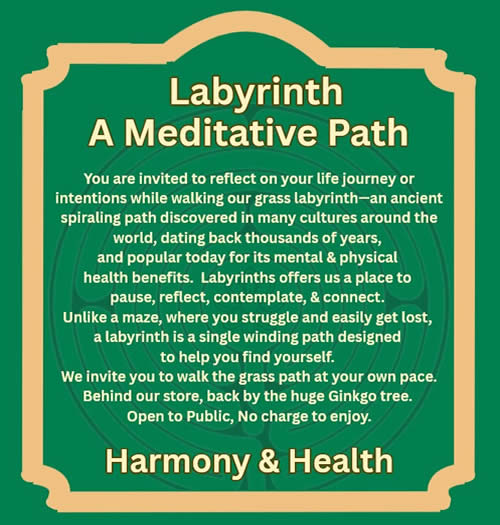
Behind Harmony & Health Wellness Center, there is a 40-ft, winding seven circuit, grass labyrinth available for all to enjoy.
The labyrinth is not tricky like a maze -a maze you lose yourself, whereas a labyrinth’s goal is to help you find yourself… walking on one path, reflecting on your thoughts or prayers, until you reach the center, then exit walking out the same path you came in on.
Most walk to feel a sense of calm, meditation, and clarity.
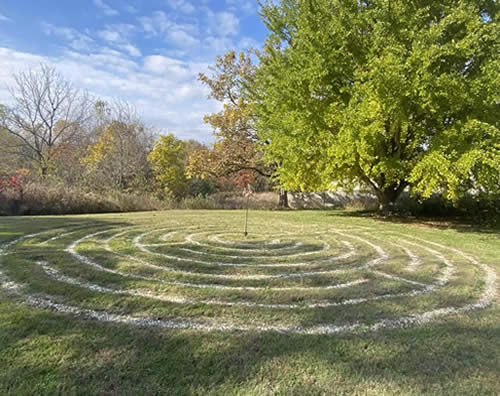
Our Design: is a deviation from the Chartres, called a Peace Labyrinth, grass labyrinth (time-honored method of installing a labyrinth)
Why circle? a circle/ circuit means a complete & closed path around which a circulating electric current can flow. Labyrinths are energetic.
Why 7 ? the number of rotations can vary from 3 on up, with 7 & 11 being the most popular. Seven is the number of completeness, strength and perfection (both physical and spiritual). It derives much of its meaning from the Bible & being tied directly to God’s creation of all things (7 days of creation), 7 Chakras, 7 Days in a week, 7 Wonders of the Ancient World, and on.
History: Labyrinth designs have been found in many cultures throughout history.
- The designs are found on coins, jewelry, pottery, and were drawn on cave walls.
- The first recorded labyrinth comes from Egypt in the 5th century B.C.
- Other labyrinths have been found in ruins of northern European cultures—it is believed that Nordic fishermen, for instance, might have walked labyrinths before heading out to sea as a way of ensuring a plentiful haul and safe return.
- After the fall of the Roman Empire, most labyrinths took on a religious nature. They could be found painted on the floors and walls of religious enclaves.
- The use of labyrinths in Christian prayer emerged during the Middle Ages. The most famous Christian labyrinth intended for prayer is the stone labyrinth inlaid on the floor of the Chartres Cathedral in France.
Present: One can find prayer labyrinths in most areas of the country, from abbeys and monasteries to college campuses & hospitals. Though the labyrinth is an ancient contemplative practice, walking the labyrinth is popular today for its mental & physical health benefits.
Walking for the First Time – the basics if you have not attended one of our intro classes
- Please note, this is a grass path labyrinth with rock marking path’s borders; thus due to the natural surroundings of the labyrinth, we strongly encourage walkers to watch their steps and wear shoes for you are walking on a rough grass path.
- Focus on breath- calm breaths before you enter & as you walk increases the ability to be able to pause and enable deep listening.
- When more than one walker, be respectful of others on the path; and if walking at different speeds; pass others with care.
- The Labyrinth Walk reflects the threefold aspect of the inner process of transformation:
- Releasing – letting go; as you walk toward the center reflect on areas of life whether as prayer, self awareness, or improvement.
- Receiving – appreciation, gratitude, grounding, as you pause for a short time when you reach the center, shifting from letting go to receiving.
- Returning –as you slowly walk path back out in reverse, focus is towards reflecting and taking new understandings back into one’s life.
As you walk, remember This is YOUR walk
Wherever it begins, your journey in life needs time and space to develop. Walking a labyrinth provides the quiet, reflective opportunity to listen more carefully for a deeper sense of knowing to emerge.